
The 1976 Assault and the Sacred Legacy of Majestic Mother Maria Rosa Toco

CHURCH OF OUR LORD JESUS CHRIST IN THE WORLD THE TOCOISTS Revived on July 25, 1949, By His Holiness Prophet Simão Gonçalves Toco EPISCOPATE HISTORICAL REMEMBRANCE: THE 1976 ASSAULT AND THE SACRED LEGACY OF MAJESTIC MOTHER MARIA ROSA TOCO His Holiness Prophet Simão Gonçalves Toco; Respected Members of the Body of 24 Elders and the Episcopate; Distinguished Members of the Central Coordination of the Men’s Order; Most Dignified Mothers of the Leadership of the Central Women’s Council; Valiant Youth of the Central Youth Ministry and the Central Children’s Council; Distinguished Guests; Beloved Brothers and Sisters. As always, it is to God the Father—Creator of Heaven and Earth—to Our Lord Jesus Christ—Our Savior—and to the Holy Spirit—the Force that Guides and Comforts us—whom we address and thank first, on this day when we commemorate the 50th Anniversary of the assault and looting of our Leader’s residence, which occurred in Block 6 of the well-known Congolese neighborhood, and the 22nd Anniversary of the burial of the body of our Majestic Mother, Dona Maria Rosa Toco. We extend our gratitude to each and every one who deigned to mark their presence in today’s Worship Service, a Special Worship Service in which we commemorate two dates and two events that are humanly sorrowful, but spiritually, clearly reveal the manifestation of the power, greatness, and invincibility of God. Hallelujah! In the history of Tocoism, some events portray the heroism of its Leader and His Followers in defending the Cause of the Most High’s Business, due to the execution of tremendously ignoble actions to which He was subjected in Africa and Europe. Teaching the Word of God—through which true Salvation is achieved, which is in Our Lord Jesus Christ—constitutes the primary reason for the presence of His Holiness Prophet Simão Gonçalves Toco in this world in which we find ourselves. The philosophy of His doctrine was and is rooted in the Holy Bible and has as its basis the teachings of Christ, that is, to cultivate the seed of love, peace, and harmony among men and nations. He never did any harm to anyone. He never used violence against anyone. He never hurt a single soul or stained His hands with blood. Upon His return from the Azores Archipelago, where he suffered severe abuse, His captors, serving the Portuguese fascist regime, classified Him in bold letters in an important media outlet of the time, Notícia magazine, as: “THE GOOD MAN.” Hallelujah! Seeing a shining Angola and a united, reconciled Angolan people constituted and constitutes His primary concern. To this effect, He spared no effort and spoke with the 3 Presidents of the then Angolan Liberation Movements: Mr. Holden Roberto of the FNLA, and Doctors Agostinho Neto and Jonas Savimbi, of the MPLA and UNITA, respectively. Regrettably, He was not understood. Instead, He was viewed as a target to be eliminated. As a consequence, on June 22, 1976, His residence was assaulted and looted by civilians and armed military personnel. Through divine protection, the worst did not happen. Our Leader and everyone who resided with Him, including Mother Rosa, were defended by the Most High Creator, Exodus 14:14. From that date forward, His Holiness began residing in a room measuring 2×3 meters, commonly referred to as the “hole,” where He remained for one (1) year and 54 days. June 22, 1976, was an extremely horrendous day, and as it happened, history recorded it. On a day like today, June 22, 2004, the body of our Majestic Mother was laid to rest. Prior to that, on a Sunday morning, June 13, 2004, the Tocoist faithful and society in general were enveloped by the sad news of her passing. Humanly speaking, without a doubt, that Sunday turned into a true nightmare for all her daughters and sons scattered across the planet we inhabit. Our Mother had just left us physically, causing tremendous grief and a high sense of pain within us. As if the state of physical sadness in which we found ourselves was not enough, the entire environment surrounding the funeral preparations was characterized by the emergence of anomalous occurrences aimed at diverting and taking control of Mother’s body by certain brothers who remain distant from the Church and ignorant of the program directed from above by His Holiness Bishop Dom Afonso Nunes—PAI MAYAMONA. The LORD willed that, on the day the body was to depart for Ntaya in Maquela do Zombo, His Holiness intervened, going personally to the airport and, with DIVINE POWER, dismantling all the malicious intents that had been planned. It was, therefore, amidst a turbulent climate that the body of our Venerated Mother was transferred from Luanda to Ntaya, where she would be buried, in the presence of His Holiness, Priest Ntemo António, Church Leaders, thousands of faithful, and the then Vice-Minister of Culture, Architect André Rodrigues Mingas, representing the Government of Angola. Our beloved Mother, Dona Maria Rosa Toco, was a true and righteous wife to our Eternal Leader, His Holiness Prophet Simão Gonçalves Toco. She never betrayed the highest figure of Tocoism. Despite the countless difficulties and hardships encountered on this journey, she knew how to stand by her husband as his true crown, in accordance with the Book of Proverbs 12:4, which I quote: “A virtuous woman is a crown to her husband…” Our Mother’s life was marked by the fact that she renounced the charms and pleasures of the world in which we live, accepting and enduring thousands of sacrifices in search of the true Life found in Our Lord Jesus Christ. Alongside her husband, she crossed rivers, cleared forests, and moved mountains, facilitating the journey of the female gender toward the Holy City of New Jerusalem. She was a Woman whose personality and deeds left an indelible mark on the History of Tocoist Women and beyond. Though we cannot see her physically, her Spirit makes its presence felt at every moment, giving us the certainty that in this world in which we find ourselves, she will never abandon
God Visited Africa: The Theophany of Prophet Simão Gonçalves Toco

On April 17, 2026, we will celebrate the 91st anniversary of the Theophany of Prophet Simão Gonçalves Toco. This special event honors his divine encounter and reflects on how it transformed lives and impacted our community. The Journey Begins At the tender age of 17, Simão Toco was a student at the former Salvador Correia de Sá High School. He was selected to join a group from northern Angola, tasked with traveling to the south of the country to learn improved farming techniques. This group comprised six local leaders (sobas) and one young student, Simão Gonçalves Toco, totaling seven members. Their journey took them from Lukala to Luanda, ultimately leading them to the Huila Province, previously known as Sá da Bandeira. The Stop in Catete During their travels, the group paused in Catete for approximately seven days due to work obligations. On the third day of their stay, around four in the morning, young Simão felt an overwhelming urge to step outside. He invited some of his companions to join him, but they were hesitant. One of them, Soba Kiala Miguel, a leader from Damba, declined, citing discomfort from mosquito bites and a reluctance to venture out. The Encounter at Jango Santo Determined, Simão ventured out alone. After walking a short distance, he noticed a brilliant light shining through the bushes, a site now revered as Jango Santo. At that moment, he struggled to continue fastening his pants. Suddenly, from the light, a figure emerged, appearing to be between 25 and 35 years old. A voice resonated from the brightness, asking, “Simão, Simão, do you know me?” Young Simão responded, “Yes, I know you; you are our Lord Jesus Christ!” The figure replied, “You are mistaken, Simão… I am not Christ; Christ is my son. Listen to me, Simão; I will place something within you that neither you nor anyone else in the world will comprehend. I see everything that is happening in the world.” As the figure spoke, it began to fade, and the light diminished until it vanished entirely. This marked the moment of the Holy Prophet’s encounter with the Most High God. Conclusion The encounter of Simão Toco is a powerful reminder of the divine presence in our lives. As we prepare to celebrate the 90th anniversary of this significant event, we reflect on its lasting impact on our community and the faith it inspires in us all. As we celebrate this milestone, we recognize that the Catete Sanctuary, where Prophet Simão Toco encountered Jehovah God, has become a national patrimony and a sacred site for people worldwide. It stands as a place where both Christians and non-Christians alike come to pay pilgrimage, honoring the profound spiritual legacy of this encounter. We invite individuals from all corners of the globe to visit the Catete Sanctuary, to experience its transformative power, and to connect with the divine presence that continues to inspire and uplift all who seek solace and enlightenment in this sacred space.
January 31, 1974 – 2026: Celebrating 52 Years of the Tocoist Youth Ministry

History is often written in the quiet moments of sacrifice. In January 1974, while the Spiritual Leader of our church, Simão Gonçalves Toco (Father Mayamona), was in exile in Ponta Delgada, the Azores, his heart remained with the faithful in Luanda, Angola. Despite the distance, his focus was on the future: the youth. In a landmark letter sent from the Azores, he reached out to his “beloved brothers, sisters, nephews, and nieces” to establish a new order of leadership. He didn’t just see children or “minors”; he saw the “seeds” of a global movement. The Pioneers: A Legacy in Action Pictured above: To the right of Father Mayamona: The first seed and 1st General Representative of the Youth, Brother Luzaísso António Lutango, who serves today as an Auxiliary Bishop. To the right of Lutango: An “Angel in person,” Sister Rosalina Cumbelembe Xavier, the first female General Representative (In Memoriam), who returned early to the Glory of the Father. To the left of Father Mayamona: The 1st Representative of Luanda, Brother Tuassolo Victor, currently an Auxiliary Bishop. To the left of Tuassolo Victor: Sister Elvira Mateus Sebastiāo, the first female Representative of Luanda and current Elder Advisor of the Central DPJ. The 1974 Decree: A Transcript of the Original Extract Below is the translated transcript of the original decree issued on January 30, 1974, which officially appointed these first representatives: From: Simão Gonçalves Toco Location: Ponta Delgada, St. Michael – Azores «Extract» 3rd. Your youth named António Lutango, brother of Quiala Lutango, is appointed as General Representative of all Tocoist boys in Angola, North and South. Respect him, just as the girl Rosalina Cumbelembe Xavier is very young—respect her. The elders of both sexes must instruct these two minors in respect and in the word of Jehovah God. 4th. The girl Elvira Mateus Sebastião is appointed as General Representative of the Tocoist girls residing in the neighborhoods of Luanda. Respect and instruct her, for Jehovah God will work His will in her. 5th. The youth Tuassolo Victor is appointed as the representative of all Tocoist boys in Luanda. The elders must instruct him in obedience and respect for the word of the Lord. 6th. Every neighborhood of Luanda, and all neighborhoods and villages throughout the North and South, shall appoint boys and girls as representatives of their respective communities. — Simão Gonçalves Toco
The Descent of His Holiness’s Sacred Body to the Earth

CHURCH OF OUR LORD JESUS CHRIST IN THE WORLD THE TOCOISTS Remembered on July 25, 1949, By His Holiness Prophet Simão Gonçalves Toco EPISCOPATE HISTORICAL SUMMARY OF THE EXPULSION OF THE HOLY PROPHET SIMÃO GONÇALVES TOCO AND HIS FIRST FOLLOWERS FROM THE FORMER BELGIAN CONGO, AND OF HIS PHYSICAL DISAPPEARANCE AND THE DESCENT TO THE EARTH OF HIS SACRED BODY. His Holiness Father Mayamona; Beloved Deaconess Mother Feliciana Fernando Nunes; Honorable members of the body of the twenty-four Elders; Esteemed members of the Episcopate; Distinguished leaders of the Central Coordination of Men’s Ministry; Beloved Mothers of Women’s Ministry; Valiant youth of the Pastoral Youth Ministry; As always, we first address OUR GOD—Creator of Heaven and Earth; His Beloved Son, OUR LORD JESUS CHRIST—Savior of the world and of humanity; and the HOLY SPIRIT—our Guide and Consoling Strength. We thank them for allowing us to be here together to remember January 9, 1950, December 31, 1983, and January 10, 1984. These are historical dates that mark, respectively: the expulsion of the Holy Prophet and his first followers from the former Belgian Congo; the physical disappearance; and the descent into the heart of the earth of the Sacred Body of the Holy Prophet Simão Gonçalves Toco in Ntaya – Maquela do Zombo, Uíge province. To our distinguished guests and to all those who left their duties to come here and share in the remembrance of these three dates with us, we offer our heartfelt thanks. Beloved Brothers and Sisters; January 9, 1950 – The Expulsion of the Holy Prophet and his First Followers from the Former Belgian Congo January 9, 1950 – January 9, 2026: 76 years have passed since the government of the former Belgian Congo finalized the process of expelling the Holy Prophet Simão Gonçalves Toco and his first followers to Angola by train to Matadi—the border region with Angola (via Nóqui). This decision was carried out in two distinct moments: on January 9 and April 6, 1950, under the Decree of the Belgian colonial authorities dated December 8, 1949. The group expelled on January 9, 1950, initially composed of eighty-two (82) people, was destined for the Loge Valley Settlement in the municipality of Bembe. Their names are listed in the book Tocoist Encyclopedia – Genesis and Doctrinal Identity, page 112. This was followed by the expulsion of three other groups whose members can be found in the book Simão Toco: The African Prophet in Angola, pages 88, 89, and 90. These followers were sent to the city of Luanda, where they were divided into two subgroups; one remained in the nation’s capital, and the other was transferred to the city of Benguela. During these events, while still in the territory of the former Belgian Congo, a Belgian administrative official named Pirote dared to raise his hand against our Leader’s face. As a consequence, God took his life, and he died. With these expulsions, beloved brothers and sisters, the troubled life of the Holy Prophet and all Tocoists began across the entire national territory, marked by imprisonments, deportations, the shedding of much blood, and deaths (with some bodies thrown into mass graves), and so on. December 31, 1983 – The Physical Disappearance of the Holy Prophet Throughout the year 1983, His Holiness Prophet Simão Gonçalves Toco withdrew to his bed for spiritual reasons. Concurrently, his physical health began to decline sharply, and on December 21 of that year, he suffered a stroke (CVA). Consequently, and lamentably, on December 31, 1983, the worst and most unimaginable scenario occurred. At 3:00 PM, he took his last breath, preceded by a mighty wind and a strong whirlwind that struck and enveloped the walls of the house where he lived, causing the shaking and breaking of a perfume bottle that sat upon his nightstand. The news, which was shockingly unpleasant for all of us, spread as fast as the wind. No one believed it. We suddenly felt as if we were trapped in a dream whose nightmare would vanish upon waking. But as time passed and spirits calmed, what we sincerely wished was a dream slowly gave way to the harsh and repulsive reality: Uncle Simão, Father Mayamona, Our Leader, the Old Man, the One who called us and showed us the Path of Salvation found in Our Lord Jesus Christ, had just left us physically. The realization of this harsh reality left us with various scars and disturbances. In those first hours, we became unrecognizable to ourselves and recognized nothing. We felt like shadows of ourselves, and everything around us seemed like a shadow. Our consciousness and judgment vanished. No one felt like anyone. We were like a balloon without air. We were completely emptied. Slowly, like a phoenix reborn from the ashes, we began to stand up and lift our heads. After all, it was necessary to tend to the funeral rites and create conditions for a dignified burial. To that end, the Tocoist children, who had appeared divided, united their ideas and combined their efforts. This allowed for the essential conditions to implement the program for the wake and funeral. In Luanda, some defended the idea of His Holiness’s body being buried in the Sant’Ana or Alto das Cruzes cemeteries. However, God intervened through the Elder Domingos Quibeta, who had previously spoken with family members and First Pastor Cutendana João; it was decided that the Sacred Body of His Holiness would be buried in Sadi Zulumongo. This eventually took place in Ntaya, Maquela do Zombo, because the physical territory of Sadi Zulumongo was uninhabited. Subsequently, the then-young men Simão Fernando Quibeta, Francisco Domingos, and João Fernando were chosen to draft the funeral eulogy, based on the written history read by young Simão Fernando Quibeta during the 64th birthday celebration of the Holy Prophet Simão Gonçalves Toco, Father Mayamona. The reading of the eulogy was conducted by João Fernando in Luanda and Francisco Domingos in Ntaya. The funeral procession, which received the support of the Angolan government and was
Commemorating the Birth of Mama Maria Rosa Toco (1932–2004)

Mama Maria Rosa Toco, affectionately known as Mama Rosa, was the wife of Simão Gonçalves Toco. She was the daughter of Alvaro Makengo and Isabel Massanga, born in the former District of Portuguese Congo, centered in Maquela do Zombo—now the Municipality of Maquela do Zombo in the Province of Uíge, Angola. Early Life and Heritage Mama Rosa was born on December 27, 1932, in the village of Mbanza Mbata (Kimankondo). She was a descendant of the Na Nzinga Uzinga Kongo Mponda, Mbangala Nzundu Tadi clan of the Bakongo tribe. She received her education at the French School of the Baptist Evangelical Mission in the former Belgian Congo (now the Democratic Republic of the Congo). Her Journey in Tocoism Her spiritual journey was deeply intertwined with the history of our faith. She was admitted into Tocoism in 1949 and was a witness to the historic Descent of the Holy Spirit. On August 22, 1949, Mama Rosa united in marriage with Simão Gonçalves Toco, the Founder of Tocoism. The ceremony was officiated by the elder and cousin of the groom, Tumissungu Pedro Cardoso, with the ritual guided by Mpululu Josefo. The union took place at the Tabernacle, located at No. 159 Mayenge Street. The marriage was witnessed by the elders Ambrósio Kinavuidi Mvanga, Mavembo Sebastião, Pedro Nzila, André Mancota, and Lutocamo Timoteo Menakuluse. Life in Exile and Family While in exile in the Azores, His Holiness Simão Toco wrote of their life together: “In Leopoldville, I married a young woman who was a student at the French School. She was also Angolan, and together we had three children—two daughters and a son. Sadly, our son passed away while I was in Ponta Albina, 25 km from Porto Alexandre. Due to the heartbreak of his passing, my wife fell ill and is currently hospitalized in the city of Ponta Delgada, here in the Azores.” Her Passing Mama Rosa passed away on June 13, 2004, following an illness. She was laid to rest on June 22, 2004, in the city of Ntaya, Municipality of Maquela do Zombo, Uíge Province. We honor her memory, her resilience, and her devotion to the Church. FOR THE GOOD OF THE CHURCH Source: COLJCW Archives
The Tocoists’ First Arrest and Congo-Angola Deportation

On January 9, 1950, the Government of the Province of Léopoldville, which is now the Democratic Republic of Congo (DRC), expelled Simão Gonçalves Toco and some of his Tocoist followers, a group totaling eighty-two (82) people. Simão Gonçalves Toco was first arrested on October 22, 1949, along with the elders he was speaking with, and they were taken to the Ndolo and Filtra prisons. He was tried on December 8 and finally expelled from the former Belgian Congo to Angola on January 9, 1950. On the afternoon of October 22, 1949, while I was at home catching a breath of fresh air, dressed only in my undershirt, the police arrived under orders from the government of the former Belgian Congo with the intent to arrest me. At that moment, they didn’t even give me time to go inside and put on a shirt. What a shame! … The Missionaries were aware of what had been discussed at the International Missionary Conference held in 1946. But when they realized the descent of the Holy Spirit, they washed their hands of it as if they knew nothing about it, much less what that phenomenon meant, for two reasons: They feared the wonders of the Holy Spirit, its growing fame, and the end of their own power in Africa. They played two fundamental roles: on one hand, they protected the colonialists from being arrested, thus facilitating their mission. On the other hand, they evangelized fearfully because they constantly had problems with the authorities, especially in São Salvador, where the Missions continually received orders to: close, open, close, open. After the night from Friday to Saturday, the day of the Holy Spirit’s descent, the Missionaries began to notice a considerable influx of members into the temple on Sunday. There was no longer enough room to accommodate so many people. So, they called me and asked: “Simão, what are you teaching these people? We have been here in Léopoldville for almost 70 years, but we have never seen so many people in the temple.” I replied, “I am teaching them the Word of God, based on some Books that came from the United States and Canada.” They then asked me to show them the Books. After I showed them, they said: “Simão, you must not teach these Books anymore, because if the Belgian authorities hear about it, we will have problems.” I asked again, “Why will we have problems? The books discuss the Bible and contain chapters from the Books of Daniel, Ezekiel, Jeremiah, and other Prophets.” In response, they told me the following: “If that’s how you understand it, read them yourself. Don’t teach them to the people anymore, because these books speak of politics and the liberation of the people of Israel, and you could be accused by the authorities.” But I did not keep silent; I continued to teach. The Spirit even reached those who were not present on July 25, the day the Holy Spirit descended. It was for this reason that on September 9, 1949, the Missionaries publicly expelled us from the Protestant Church. Our desire was to continue praying within the Church, in Spirit and in truth, as Christ narrates in the book of St. John 4:22-24. After being expelled from the Protestant Church, we did not stop praying. Tocoism emerged from that date forward. As if our expulsion from the Protestant Church were not enough, the envious—due to the fame of the Holy Spirit’s descent and its great wonders—went to complain about us to the Belgian authorities, because their own temples were now empty. Following the complaint, we were arrested and put in Ndolo prison on October 22, 1949. However, God had already revealed everything to me three days before the arrest. Jehovah God had told me the following: “Simão, you will be arrested and subsequently sent to your homeland (Angola), because it is not here in Kinshasa where the true Spirit will work. Whatever suffering you have, even if everyone abandons the Word, you must not abandon it.” I kept these Words and always remembered what Jehovah had told me on April 17, 1935, in Catete: “I WILL PUT A THING IN YOU, AND NEITHER YOU NOR THE WORLD WILL KNOW IT.” Everything was coming true; as a result, here I am today with the people he gave me, to show them the path of salvation, Hebrews 2:13. In summary, we were deported, killed, tortured, burned alive, and exiled to the Azores and São Tomé and Príncipe. Thanks to the One who sent me, the Word of God was not imprisoned or burned. On the contrary, they facilitated its expansion, because I did not have the money to send Tocoist Missionaries to every corner of the country. They were the facilitators, ALLELUIA TO MY GOD. Nominal List of the First Group of Tocoists Expelled The following is the transcribed nominal list of the Tocoists in the first group expelled by the Belgian authorities: Simão Gonçalves Toco Kinavuidi Ambrósio Mvanga Mvuama Garcia Dilunguangu Matias Figueredo Ntony Pululu Joseph Luyeye Ferdinand Cade Carlos Makoka João (The first Tocoist dissident who joined the Jehovah’s Witnesses; he was part of the first group that arrived in Luanda) Kalemba António Makangu Norberto Armando Jorge Nkosi Bunga Malinga (son of João Bunga) Vondo Leon ilesivel— Mpungi Filemon Lumingo Alphonse Kidimbu Jorge Mbala António Dilu Simon Makaya joão Mfinda Josefo João Lumpini Sungi Miguel Makundi Sebastião Nteka Simão Veto Dominique Panda Afonso Mfinda David Kama Gabriel Pulu Thomas Kiala João Kiyalama Miguel Mfuka Thomas Kinzisi Luavualu Feta Manuel Masaki Nicolas Lubaki Miguel Vemba Samuel Silumeso Bonifácio Mbengi Ambrósio Kalemba Kuma Binga Sebastião Mosilongwa António Dombele André Sezala Garcia Mbasi Pedro Dituvuila Miguel Masumu Pedro Dandanda Pedro Jackson Lufwakende Nicolas Lumpini Samuel Mambauka Miguel Telemeno Luvualu Panzo Simão Zandi André Domingos Pedro Zingi Sebastiao Masanga Simão (Mother of Mama Rosa Toco) Panda Vasco Pedro Destino Dondão Paul Dombasi Sebastião Bunga Ferdinand Miguel Makongo Kete Luisa (Walosa) Maria Rosa Toco Zemba Antónia Masamba
The Triumphal Return of Simão Toco (1963 – 1974)
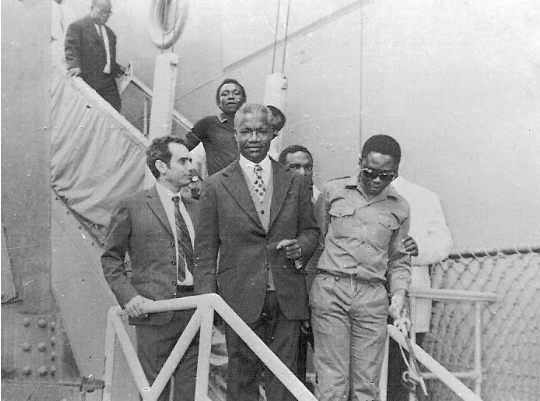
August 31, 1974 – The Return from the Azores (Portugal) to Luanda, with stop in Lobito A Brief Summary of the Stay in the Azores and the Return to Angola After 11 Years in Exile On July 17, 1963, Prophet Simão Gonçalves Toco was deported to the Portuguese island of the Azores. The colonial authorities considered his presence a threat because of the way he awakened the consciences of the local people through the Word of God and the principles of freedom that would later lead to Angola’s independence. As far back as the 1940s, his concern was already to see Africa freed from the darkness of oppression and from the great empires that colonized the continent. Departure from Luanda to Lisbon Before leaving, he said farewell to the church leadership and the people, giving them instructions to remain united. He asked that upon his return, he would not find the church divided. For administrative matters, he appointed trusted brothers to guide the church and encouraged everyone to remain strong in faith during his absence. He traveled with his wife, Maria Rosa Tôco, his daughters Ilda and Esperança, his nephew João Sivi Tôco, and his sister Maria de Fátima (who later returned to Angola). Arrival in Lisbon and Transfer to the Azores In Lisbon, Prophet Toco was received by the Portuguese Prime Minister at the time, António de Oliveira Salazar. Their meeting included strong disagreements over the church, the preaching of the Word of God, and the war in Angola. On the way to the Azores, something extraordinary happened. According to Prophet Toco himself, the pilots had been ordered to throw him into the ocean. When they tried, the plane suddenly stopped in midair and would not move. Shocked, the pilots and a priest on board began to pray, but the plane remained suspended. Only after Prophet Toco prayed to God did the engines start again, and the plane continued safely to the Azores. Life in the Azores Upon arrival, he was told he would no longer be considered Angolan. He responded firmly:“My homeland will never change. I was born in Angola, and I will always be Angolan.” He also foretold that one day, when two people (one Black and one White) would come looking for him in the Azores, it would mark the end of his exile and the time of his return. He lived on the island for 11 long years. During that time, he supported and guided the church through thousands of letters. These letters strengthened the people spiritually, reformed the church at every level, and kept alive the connection between the Prophet and his followers in Angola. On August 31, 1974, the prophecy was fulfilled. After years of sacrifice, exile, and faith, Prophet Simão Gonçalves Toco returned triumphantly to Luanda, Angola. Source: Vida e Obra, by Simão Fernando Kibeta
An Autobiography of Simão Gonçalves Toco, Founder of Tocoism

My father’s name was Ndombele Luvumbu Bitopo, or Tôco, and my mother’s name was Ndundu Nsimba Tôco. At the time of my birth, my mother had twins, namely Adam and Eve. I was the first to be born, and the first part of my body to emerge were my legs, followed by my head—a curious fact about my birth. Eve passed away shortly after, and I survived. Both of my parents died in the same week, on a Monday and a Friday, between 1924 and 1925, during an outbreak of smallpox in the region. Simão Gonçalves Toco is not my birth name; it was given to me by my brother Domingos Kibeta, who entrusted me to the missionaries. My mother named me MAYAMONA, which was later changed to OMA YAMONA and OMA IMONANGA. I am originally from Maquela do Zombo in the district of Portuguese Congo. I was born on February 24, 1918. In 1926, I entered the BMS Mission in Quibocolo, which was mandatory and not by my choice, at the age of 8. On October 2, 1928, I was taken to Leopoldville until 1929, when Reverend Arthur Enock Guest came to get me, but even then, I did not want to return to Quibocolo. In summary (because it’s not worth telling you everything), in 1930, I went to Thysville and began attending the BMS school there. Reverend Jennings wanted me to go to Banza Manteca, Gombe Lutete, or Kimpese to study to become a teacher (nlongi), but I refused because Reverend Guest kept bothering me with successive letters asking me to return to Quibocolo. Reverend Jennings wrote a request letter to Mr. Guest, but he denied the request. There was a call for Maquela, my hometown, and my uncle and I went. When we arrived, Reverend Guest called again, asking me to return to the Mission in August 1931. Soon after arriving, within two or three days, I was baptized. On July 2, 1933, we marched to Luanda to continue my studies, where I stayed for four years. I completed primary school at the Evangelical Mission in Luanda and enrolled in high school, where I reached the second year. I returned to my hometown in Zombo to continue working at the Quibocolo mission. In 1938, I was transferred to the Bembe mission, where I stayed for 4 years. In 1942, I went to Belgian Congo in Leopoldville and continued to serve at the Protestant Mission in Leopoldville for 7 years. Source: Joao Daniel – Tocoistas.net